Creative Arts and the Sciences
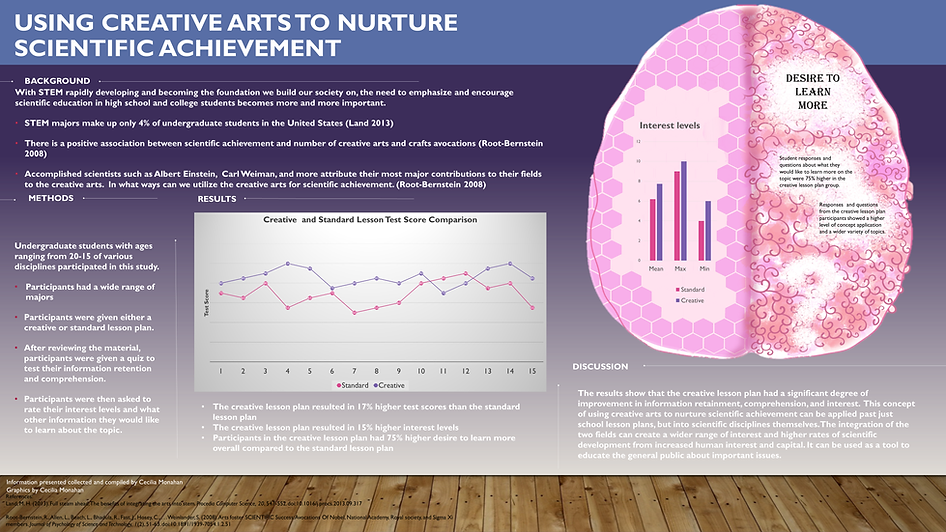
The creative arts and the sciences work together to nurture progress through natural curiosity, imaginative ideas, and technical advancements. Environmental artists use the creative arts to educate the public and help them to understand the serious environmental issues we face and inform them on the change that must made in order to mitigate that risk. Studies show that scientists who are active in the creative arts are much more likely to make both major and minor contributions to their field, and many well-known scientists, such as Albert Einstein, credit the inspiration for their major contributions to their field from their creative avocations (Root-Bernstein et al., 2008). The integration of creative arts into science lessons resulted in higher levels of knowledge retention, comprehension, interest levels, and desire to learn more when compared to traditional methods (Gurnon et al., 2013) (Goodnough, 2011). Combining the arts and sciences provides new perspectives for breakthroughs as participants can view the subject matter through both a creative and scientific lens (Mumford & Gustafson, 1988).
Below are my results of a study I conducted to measure the effects of creative arts integration on knowledge retention, comprehension, interest levels, and desire to learn more.